
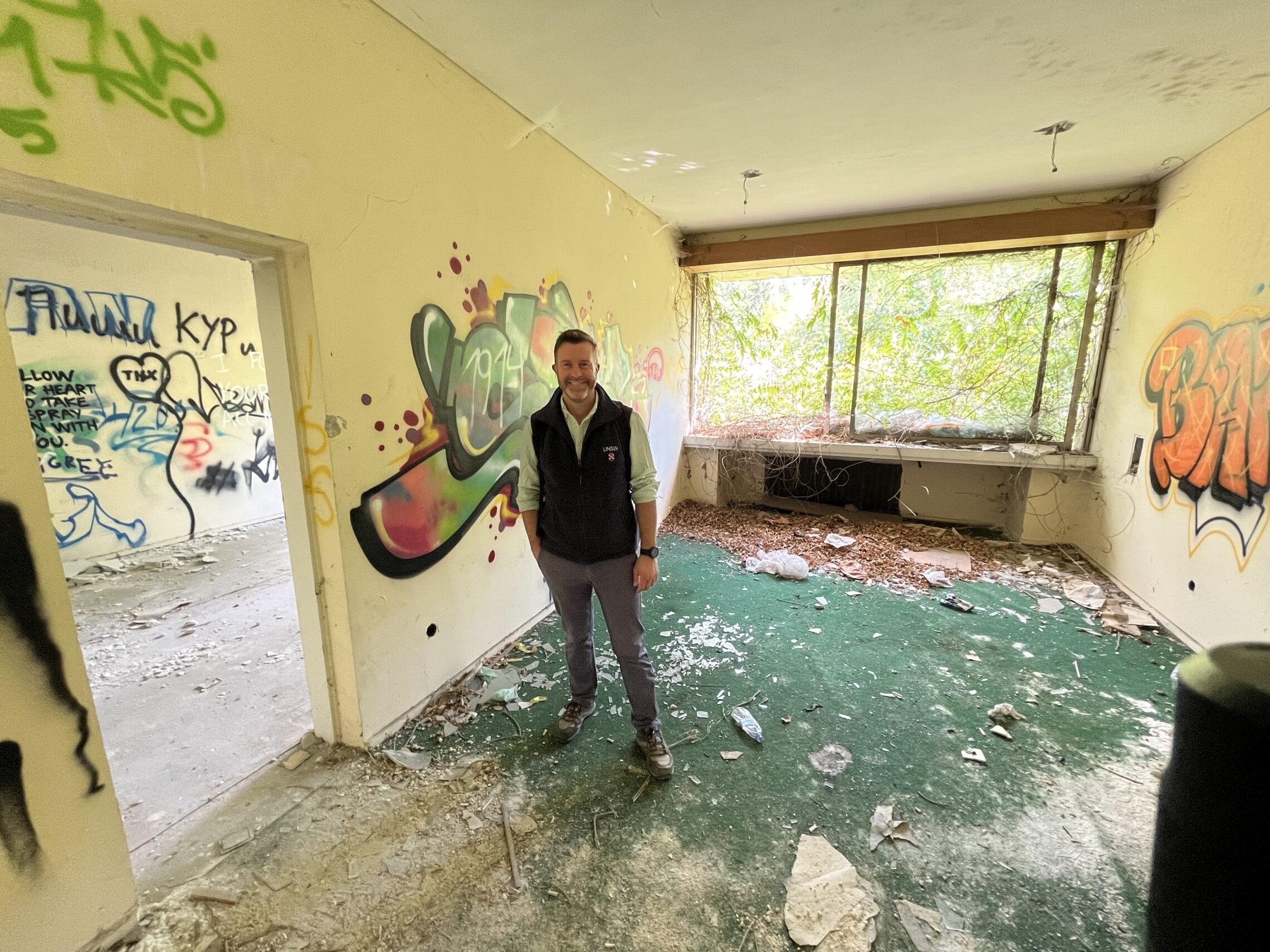
Hidden in the forest outside Sofia, the former Bankya Residence is slowly collapsing. Once associated with Bulgaria’s communist leadership and later with an extraordinary Japanese golf project, its ruins raise a simple question: should such a place disappear, or can history be turned into something new?
There are abandoned buildings, and then there are buildings that make you stop.
The former Bankya Residence, hidden among the trees on the outskirts of Sofia, belongs to the second category.
I had already seen the complex from outside. Then I returned.
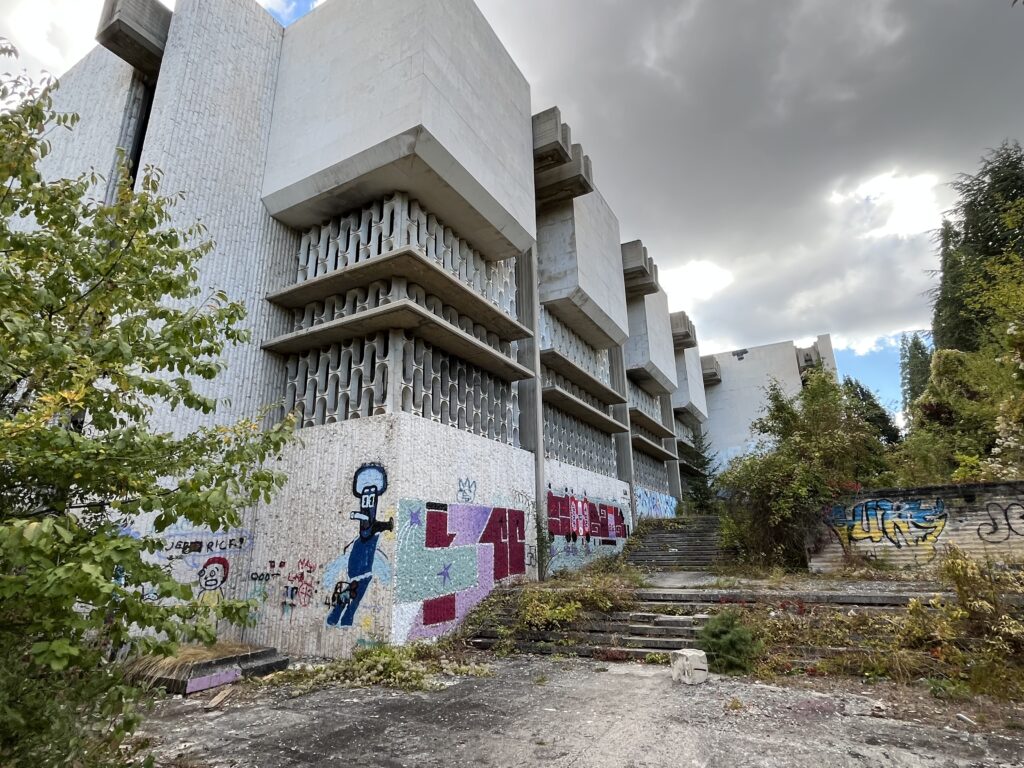
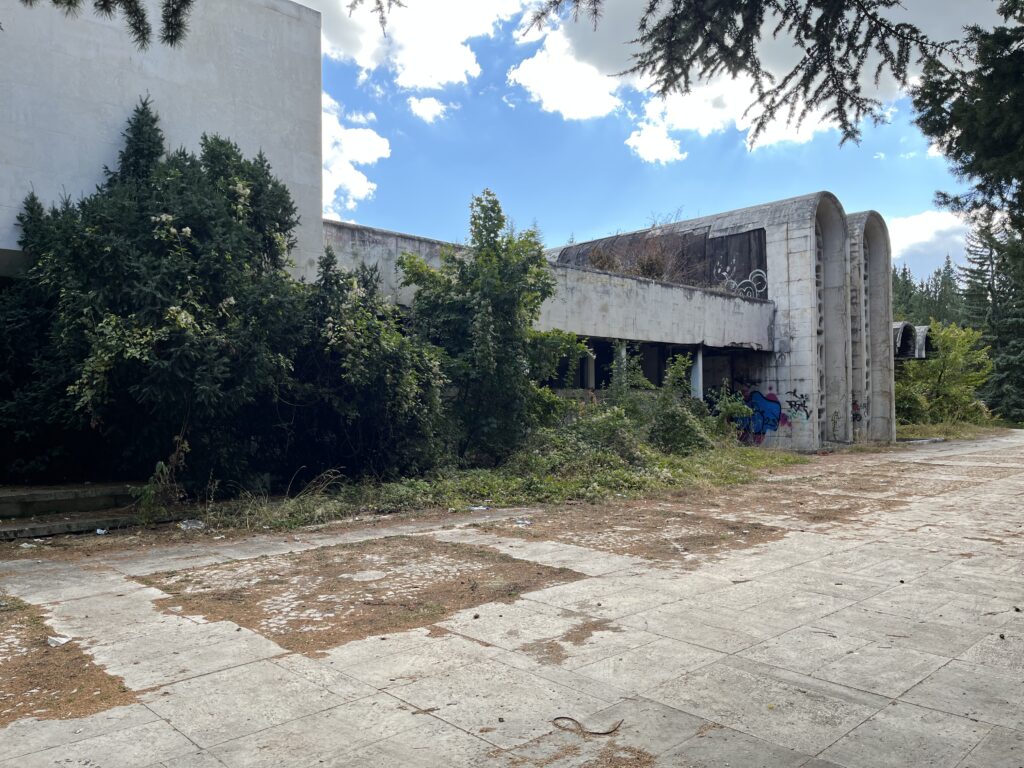
Walking around it more slowly — and seeing part of the interior — completely changed my perception of the place. Yes, it is ruined. Windows have disappeared, walls are covered with graffiti, water and vegetation have entered the building, and many interior elements have been destroyed.
But beneath all of that remains something surprisingly grand.
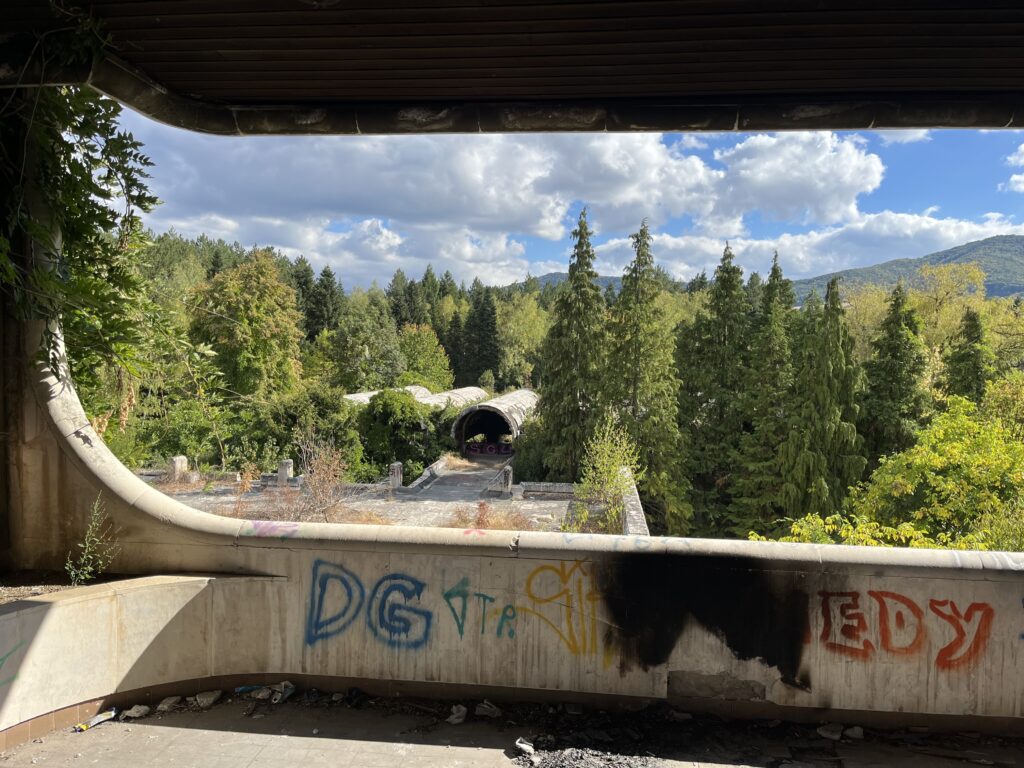
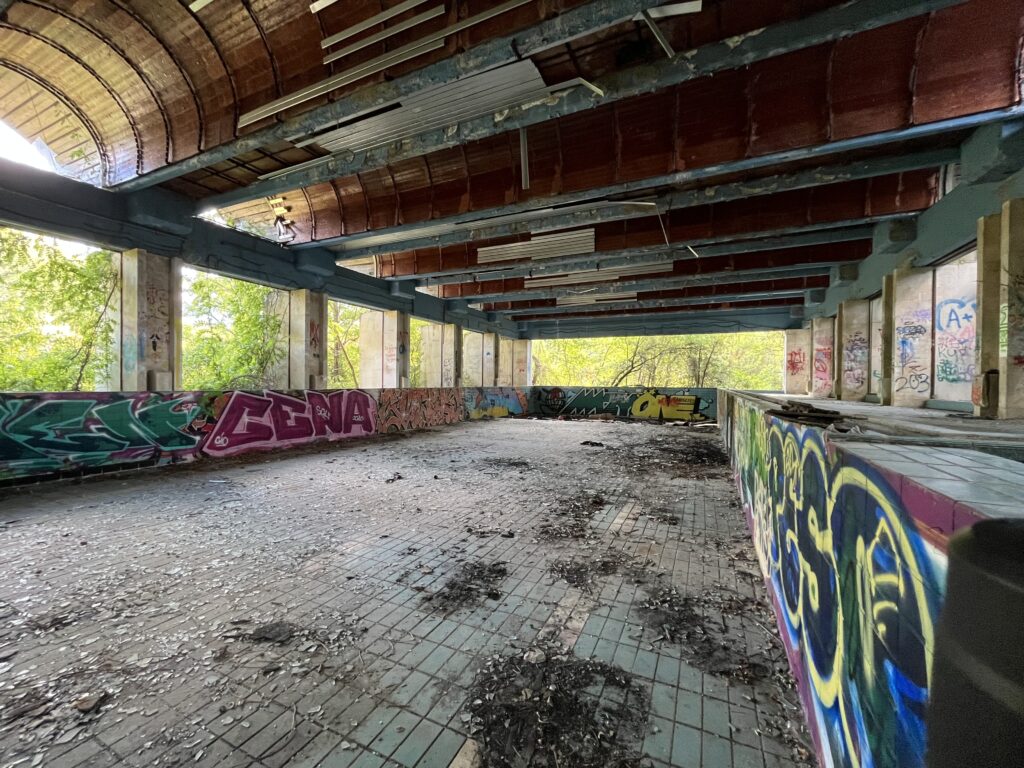
The architecture is monumental without being completely oppressive. Huge volumes emerge from the forest. Curved concrete roofs alternate with sculptural facades. Large windows once opened towards the surrounding landscape. Long corridors, halls and terraces reveal just how ambitious the building must have been.
Even today, after decades of neglect, you can still imagine how impressive it once looked.
And that makes its present condition even harder to understand.
A warning before watching the video
I filmed part of the interior during my visit and have included the video below because it gives a much better sense of the scale and present condition of the Bankya Residence than photographs alone can provide.
But this is not an invitation to explore the building.
The complex is badly deteriorated. There is broken glass, damaged ceilings, exposed structures and debris throughout the interior, and there is no way for an ordinary visitor to know which elements may have become unstable after decades without proper maintenance.
I therefore do not recommend entering the buildings. The video is published as documentation of their present condition, not as an urbex guide or an encouragement to follow the same route.
[VIDEO – Inside the abandoned Bankya Residence]
From sanatorium to Todor Zhivkov’s Bankya Residence
Construction of the complex began in 1973, according to Bulgarian National Television, with architect Pavel Nikolov responsible for the project. It was initially intended as a sanatorium for prominent figures, but Todor Zhivkov came to appreciate the location and turned it into one of his residences. He reportedly spent increasing amounts of time there after the death of his daughter Lyudmila Zhivkova in 1981.
The scale alone tells you this was never an ordinary retreat.
The former governmental balneological complex occupied a property of roughly 450 decares — around 45 hectares — and consisted of five interconnected blocks.
What struck me while walking around it was an uncomfortable architectural contradiction.
Communist Bulgaria produced enormous numbers of repetitive apartment blocks. They still define entire neighbourhoods throughout the country.
Yet when the regime built for itself — government residences, ceremonial spaces, hotels and representative buildings — it was often willing to experiment with architecture, materials, scale and landscape in ways that ordinary housing rarely enjoyed.
Bankya is a striking example.
You do not have to feel any nostalgia for the political system to recognise architectural quality when you see it.
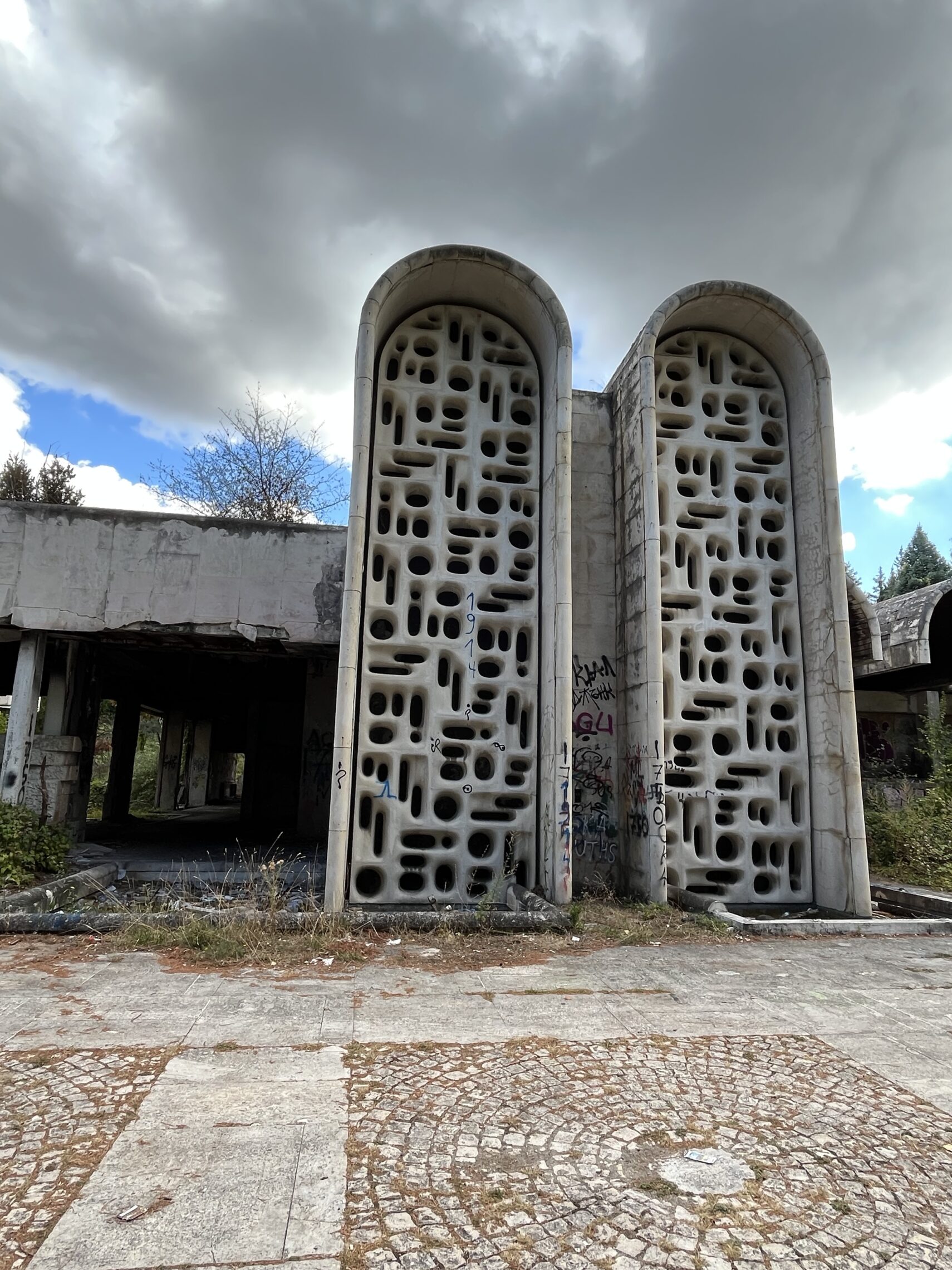
The curved structures, geometric screens, stone facades, terraces and relationship with the surrounding forest reveal genuine ambition.
Whatever one thinks of the people for whom it was constructed, this was not a banal building.
Then came Masako Oya and one of Bankya’s strangest dreams
The story becomes even more unusual after the fall of Bulgaria’s communist regime.
In the early 1990s, the residence became associated with Japanese businesswoman Masako Oya and a company called Sofia Golf and Country Club.
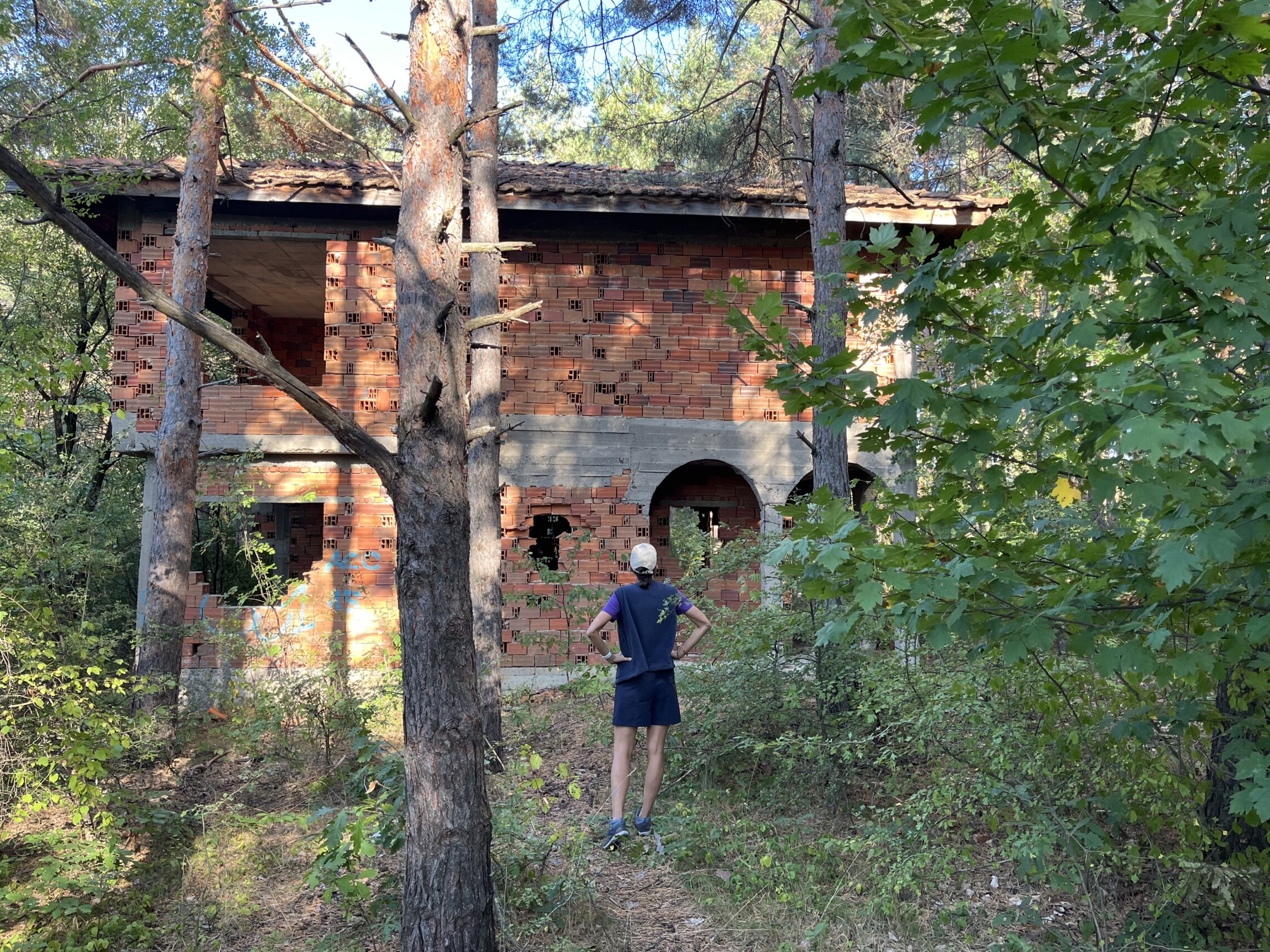
The project envisioned far more than simply reusing the old residence. Plans reportedly included a golf course, business and congress facilities, medical functions and 50 detached houses for sale or rent. Retrospective Bulgarian reporting says that 32 of the planned houses were started but never completed.
Those houses are still there.
Walk through the forest around the residence today and suddenly, between the trees, another unfinished villa appears.
Brick walls. Concrete columns. Roofs. Empty window openings.
And then another.
And another.
Within a short walk, you pass from the architectural remains of communist political privilege to the remains of the chaotic entrepreneurial optimism of the early 1990s.
Two systems.
Two ambitions.
Two failures.
And the forest slowly absorbing both.
The saddest part is that the architecture is still there
Standing inside the Bankya Residence, I found myself thinking something very simple:
What a waste.
Not every building from the communist period deserves to be preserved, nor does age alone make a structure valuable.
This complex is different. Despite the graffiti and broken glass, it retains a remarkable architectural identity.
Its bold shapes, vast interiors and unusual roofs remain striking, as do its stone surfaces, concrete screens and views across the surrounding hills.
Someone designed this place carefully, spent considerable resources building it.
And nearly fifty years later, even after extensive deterioration, that original idea remains visible.
There is something deeply frustrating about allowing such a building simply to disappear through neglect.
Restore it, demolish it — or give the forest back its land?
There is an obvious problem with romantic ideas about abandoned architecture: nobody looking at the building from the outside can know whether restoration still makes economic or structural sense.
Parts of the complex have been exposed to water, frost, vegetation and vandalism for decades.
Restoration may still be technically possible, although parts of the structure could be beyond saving. Rehabilitation might also prove far more expensive than demolition and rebuilding.
Those are questions for structural engineers, architects and economists, not for someone walking through the ruins with a camera.
But suppose demolition ultimately proves to be the chosen option.
Then another question arises.
Why automatically build something else here?
Sofia is not suffering from a shortage of concrete.
If the architectural complex has genuinely reached the point where it cannot reasonably be preserved, returning substantial parts of the site to the forest would at least have a logic of its own.
The same question applies to those unfinished villas.
Complete them?
Demolish them?
Reuse the structures?
Remove everything and restore the landscape?
Leaving half-built houses standing indefinitely among the trees is not really a solution either.
And what if the Bankya Residence could actually be saved?
This is where the place becomes much more interesting.
The most obvious commercial reuse would probably be a hotel, spa or luxury resort.
Bankya has mineral water. Sofia is nearby. The wooded setting is beautiful.
One can easily imagine the business plan.
But there is another, much more symbolic possibility worth imagining.
What if a place created within the privileged world of communist power were transformed into something that represented almost the opposite values?
Not another exclusive residence.
Not a nostalgic museum recreating the rooms of the former leadership.
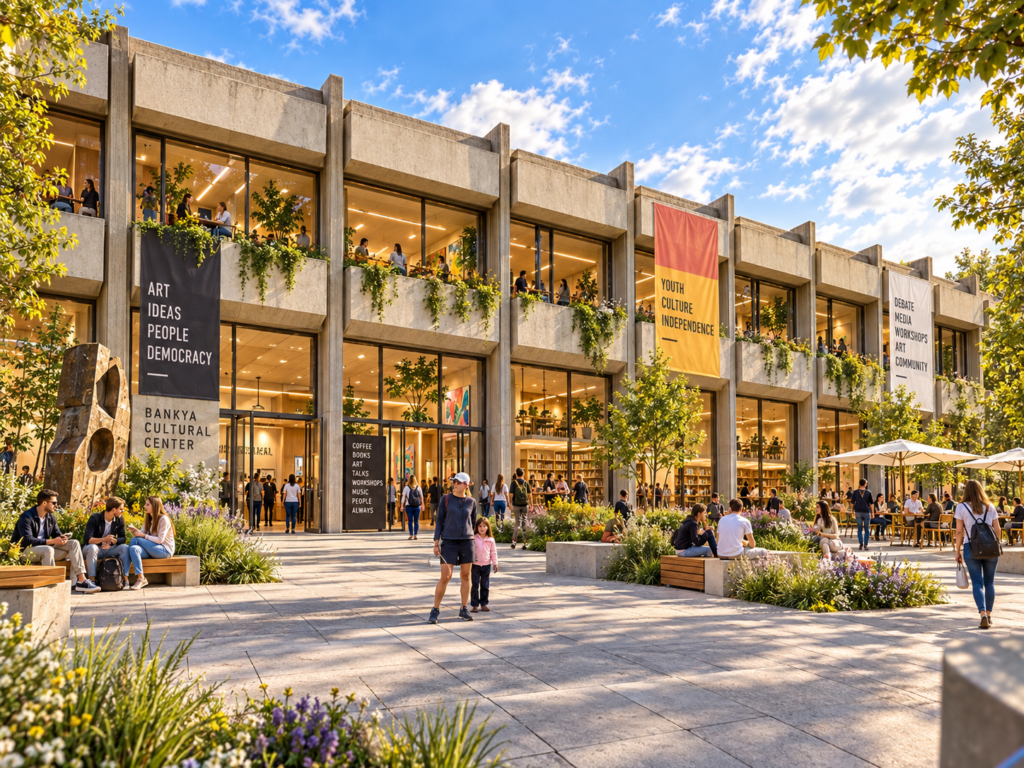
But a place devoted to young people, culture, ideas, history, artistic creation, independent thought and public debate.
A former residence of political power becoming a cultural and civic campus.
There is a certain historical irony in the idea.
Turning the meaning of the building upside down
Imagine keeping the architecture almost intact.
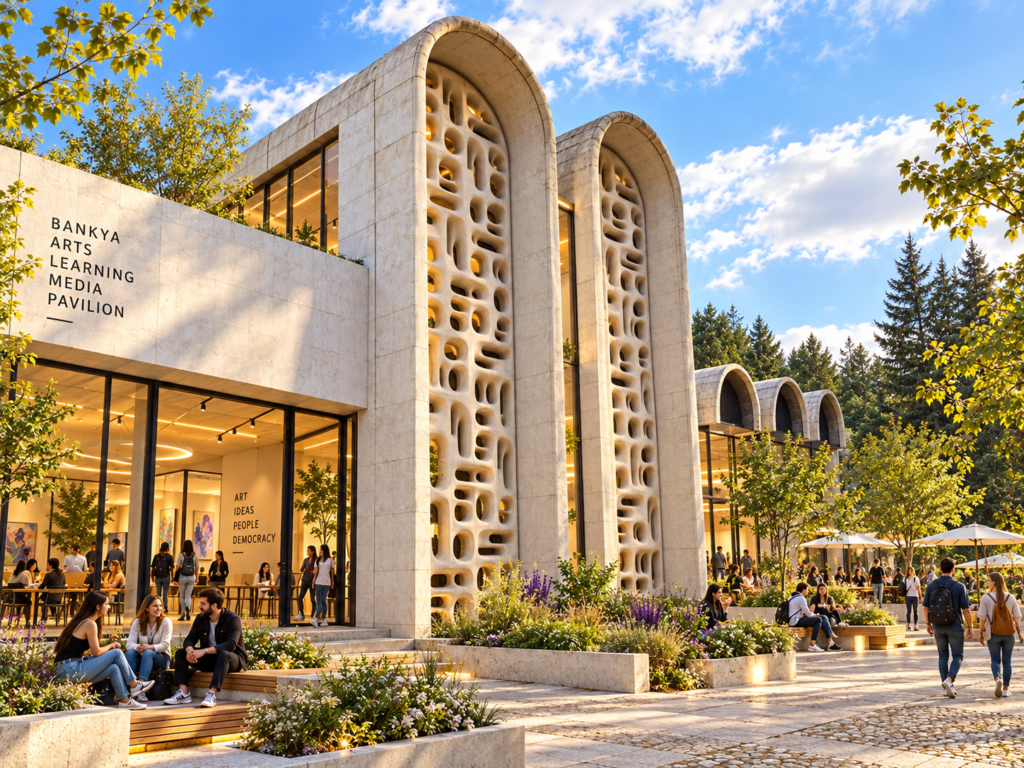
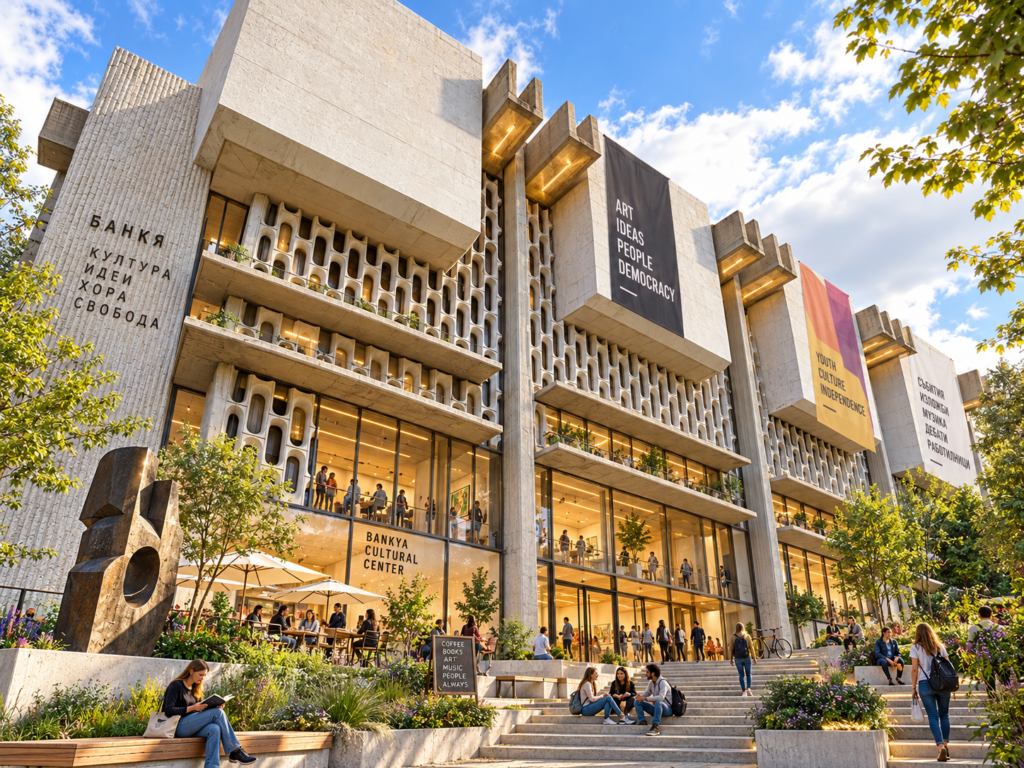
The large facade restored rather than replaced.
The extraordinary concrete screens cleaned and preserved.
The former halls turned into exhibition and performance spaces.
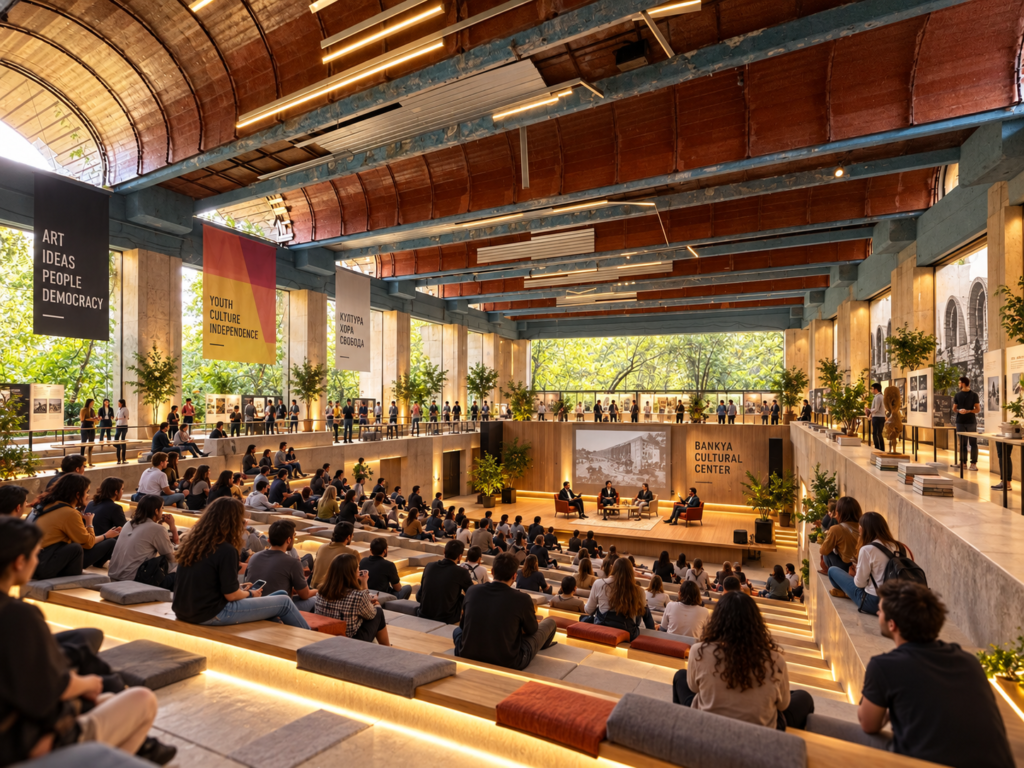
One of the huge interior volumes could become an auditorium for lectures, debates, concerts and documentary screenings.
Other wings could contain artist studios, temporary exhibitions, workshops, a library, spaces for independent cultural organisations or university programmes.
Part of the complex could tell the history of communist Bulgaria without either glorifying it or pretending that it never existed.
And the young generation would occupy the rest.
Students debating.
Artists working.
Journalists meeting.
Musicians performing.
Children visiting exhibitions.
Researchers discussing history.
People drinking coffee in spaces that were once reserved for a tiny political elite.
That reversal of meaning would itself become part of the architecture.
The conceptual images accompanying this article are not actual redevelopment plans. They are visual thought experiments created from photographs of the existing residence: an attempt to imagine how exactly the same architecture might look if it were restored and given an entirely different purpose.
The point is not the precise design.
It is the idea.
A building from the communist era does not have to remain a communist building
There is often an uncomfortable question surrounding architecture inherited from authoritarian regimes.
Should it be destroyed because of what it represents?
Preserved exactly as it was?
Turned into a museum?
Ignored until nature solves the problem?
There is another possibility: change its meaning through use.
Buildings do not possess political ideas by themselves. People give them meaning.
A residence designed for the powerful can later become a public place.
An architecture associated with exclusion can become accessible.
A building created under censorship can host free speech.
That would not erase the past.
Quite the opposite.
The contrast would make that past visible.
The debate about Bankya is no longer purely hypothetical
There is an important contemporary dimension to all of this.
The Bankya Residence remains recorded as public state property. In September 2025, Sofia municipal councillors considered a proposal for the municipality to acquire the approximately 380,000-square-metre property from the State free of charge. The Sofia Municipal Council ultimately rejected the proposed decision.
At the same time, Sofia’s urban-planning authorities have included the State Residence in Bankya among significant examples of post-war architecture identified through the city’s New Architectural Heritage initiative. The research programme is examining buildings that could potentially merit cultural-heritage protection and explores ways in which significant post-war architecture might be preserved while continuing to evolve and be used.
So the future of the building is not simply an abstract question raised by someone wandering through an abandoned site.
There is already a real discussion around its architectural value and future ownership.
What eventually happens is unresolved.
Bankya deserves a decision
A detailed structural assessment may well prove that my vision for a cultural centre is unrealistic. Only part of the complex might be saved, while the unfinished villas may have no viable future. In the end, another use could make more sense.
What is becoming increasingly difficult to defend, however, is the lack of any long-term solution. Neglect is not preservation, and abandonment is not a neutral choice.
With every winter, more water seeps in. Broken windows hasten the deterioration, while the loss of architectural features makes restoration increasingly difficult.
Eventually, time makes the decision for us.
The ruins tell the story of three Bulgarias
That may ultimately be what fascinates me most about this place.
The Bankya Residence contains several chapters of modern Bulgarian history almost on top of one another.
First came the communist state and its architecture of privilege.
Then came the extraordinary optimism of the early transition years: a Japanese investor, a golf course, luxury villas and dreams of a completely different economic future.
Then came abandonment.
And now comes a fourth possibility, still unwritten.
The site could disappear.
It could remain a ruin.
It could become something commercial.
Parts could return to nature.
Or the architecture could acquire an entirely new meaning.
That is why Bankya Residence is worth talking about.
Not simply because abandoned buildings make beautiful photographs.
But because sometimes a ruin forces us to ask a much more interesting question:
What do we want to do with the history we inherit?
